
Integration of Simulation
Pitt’s OTD program includes an extensive simulation curriculum that strengthens critical thinking skills to help advance practice skills. Instead of memorizing and reciting information, students in the program have opportunities to problem solve and evaluate dynamic situations in the moment, decide for their patient and assess the outcomes in real time – all without risk to a real patient’s safety.
Simulations occur each term at Pitt, prior to Level II fieldwork. Each simulation experience builds on the last and is designed to integrate current coursework and reflect real-world practice. As students progress through the program, the focus of each simulation shifts to support continued growth and professional confidence.
Through the OTD program’s simulation education, Pitt OTD students can expect to:
- Build confidence and reduce anxiety through supported practice
- Receive constructive feedback to help them identify specific areas for improvement
- Focus on “soft” or “challenge” skills like interpersonal interactions and communication
- Customize their learning and tailor it to meet individual needs by adjusting the level of challenge
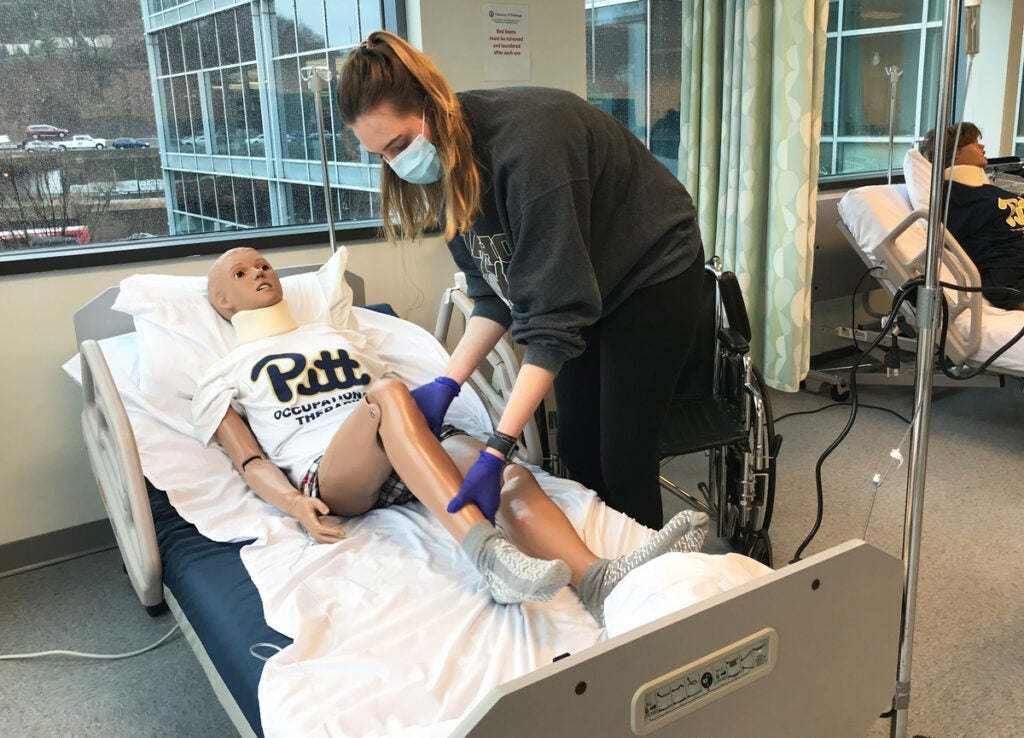
Advancing Occupational Therapy Education Through Clinical Simulation at Pitt
The simulation provides students with realistic, interactive experiences that mirror the complexities of real-world clinical practice within a safe, structured environment.
Read the full storyPlan of Study*
Year 1
Fall Term 1 (15 Credits)
- Foundations of Occupation
- Body Functions and Structures: Anatomy**
- Therapeutic Approaches 1**
- Clinical Seminar 1
- Principles of Assessment**
- Critical Appraisal of Evidence
- Human Performance Analysis**
Spring Term 2 (15 Credits)
- Neurobehavorial Science**
- Clinical Seminar 2
- Psychosocial/Cognitive Theory and Practice**
- Occupational Therapy and the Health System
- Therapeutic Approaches 2**
- Fieldwork Education A (FW I)**
- Clinical Conditions 1
- Activity/Context Theory and Practice
Summer Term 3 (11 Credits)
- Clinical Seminar 3
- Neurorehabilitation Theory and Practice**
- Biomechanical Theory and Practice**
- Fieldwork Education B
- Clinical Conditions 2
- Adaptation/Technology Theory and Practice
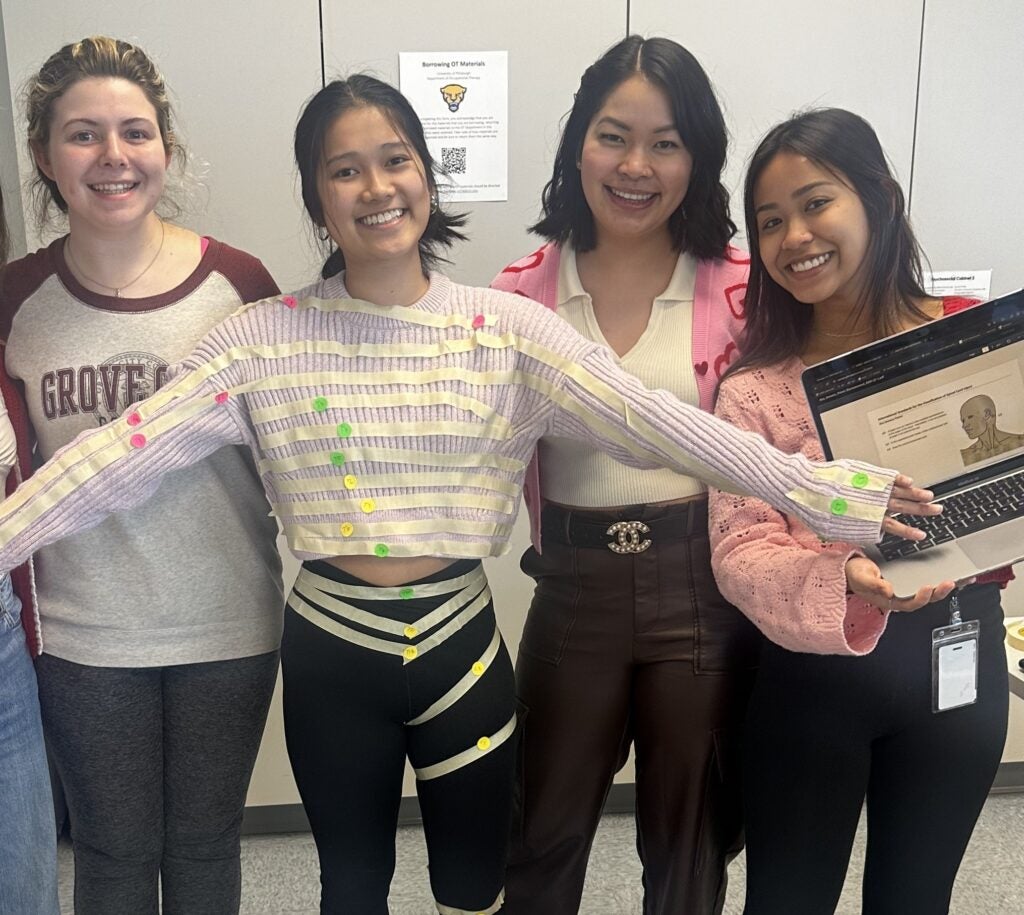
First-Year Doctor of Occupational Therapy Students Share Their Experience
As the past academic year came to an end, we asked first-year Doctor of Occupational Therapy students about their experiences. Learn more about what they had to say about the program!
Read the full storyYear 2
Fall Term 4 (13 Credits)
- Clinical Seminar 4
- Developmental Theory and Practice**
- Productive Aging Theory and Practice**
- Management Of Occupational Therapy Practice
- Fieldwork Education C (FW I)**
- Project Development 1
- Clinical Conditions 3
Spring Term 5 (13 Credits)
- Fieldwork Education D (FW II)**
- Fieldwork Education E (FW II)**
Summer Term 6 (7 Credits)
- Fieldwork Education E (FW II)**
Year 3
Fall Term 7 (12 Credits)
- Advanced Theory and Practice**
- Project Development 2
- Advanced Concepts in Professional and Clinical Reasoning
- Advanced Concepts in Health Policy and Advocacy
- Leadership Development
Spring Term 8 (13 Credits)
- Experiential Preceptorship**
- Professional Development Seminar
*Curriculum is subject to change.
**Course includes laboratory, fieldwork, or experiential component.
More on the Advanced Theory and Practice Course
This course examines select theoretical perspectives, practice areas, evaluation procedures, intervention protocols and professional issues in-depth. Pitt’s OTD program prepares students beyond the standard entry-level clinician knowledge and skills.
Students rank their choice of modules, which cover various established and emerging OT specialty areas. This allows students to personalize their content to explore and pursue areas of interest. Some of these modules range from well-known OT specialties (such as feeding, splinting/hand therapy, wheelchair fitting) to more up-and-coming specialties (such as pelvic health, smart technology). Faculty work with practicing clinicians in each specialty area to co-develop robust, evidence-based pedagogical experiences. The modules are primarily lab-based, emphasizing practical application and experiential learning.
The main assignments for this course focus on students critiquing evidence and engaging in detailed discussion to apply evidence to clinical practice and advocacy efforts, directly targeting Pitt OT’s mission of educating evidence-based practitioners and leaders in the field.
Additional Information
- Admission to the OTD program is only available on a full-time basis. Term 1 begins at the end of August.
- A GPA of at least 3.00 is required in the OTD program.
- A misdemeanor or felony charge or conviction may affect a student’s ability to complete courses with a clinical component (fieldwork courses and experiential preceptorship).
- NOTE: The OTD program requires students to complete fieldwork education experiences and a doctoral capstone experience (experiential preceptorship) at facilities external to the University of Pittsburgh. All OTD students are responsible for securing required resources and completing required documents to participate in fieldwork education and the doctoral capstone experience including but not limited to transportation, physical examinations and associated testing (i.e., drug screen, vaccinations), health insurance, liability insurance, background clearances, CPR/AED training, first aid training, education modules, parking, housing, food, and clothing. Additionally, certification and licensure requirements include inquiries as to whether the applicant has been convicted of a misdemeanor, a felony, or a felonious or illegal act, including those associated with alcohol and/or substance abuse. Note that a felony conviction may affect a graduate’s ability to sit for the certification examination or attain state licensure.