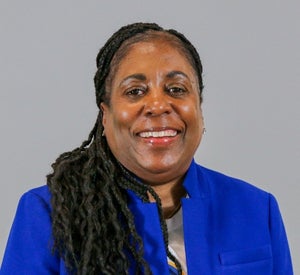
Through the American Physical Therapy Association (APTA) Board of Directors and House of Delegates, physical therapists from across the country help shape the priorities and future direction of the profession. Three University of Pittsburgh Department of Physical Therapy, School of Health and Rehabilitation Sciences, faculty members are contributing to this work nationally. Kim Nixon-Cave, professor of physical therapy, serves on the APTA board of directors, while Hallie Zeleznik, associate professor of physical therapy and vice chair for clinical education, and Allyn Bove, assistant professor of physical therapy and director of Doctor of Physical Therapy (DPT) education for the on-campus option, serve as elected delegates in the APTA house of delegates.
The board of directors provides strategic leadership for APTA, while the house of delegates serves as its primary policy-making body, bringing delegates together to debate and vote on positions and policies affecting the profession.

APTA House of Delegates
Bove, now in her sixth year representing the Southwest District of Pennsylvania, has seen firsthand how that process can translate into action. One of her most meaningful experiences involved working with colleagues from APTA Washington on a motion addressing Medicaid reimbursement for physical therapy services. Bove spoke before more than 500 colleagues in support of the motion, which passed with 98% support. APTA has since developed resources to help state chapters advocate for increased reimbursement.
Zeleznik, now in her second year as a Pennsylvania delegate for the Southwest district, pursued the role in part because she wanted to better understand how decisions affecting the profession are made. Her experience has reinforced the importance of bringing different professional perspectives into those conversations.
“If we are not in the room helping shape those decisions, we are leaving it to others to decide our future for us,” Zeleznik says. “Professional service is one of the clearest ways to bring that perspective to the table.”

APTA Board of Directors
At the strategic level of the association, Nixon-Cave is serving her second elected term on the APTA board of directors. During five years of board service, she has worked with fellow board members and APTA staff to establish strategic priorities and guide national initiatives. She has also served on the APTA Executive Committee and as a liaison to multiple board-appointed groups.
Nixon-Cave’s election also marked a historic milestone. She became the first Black/African American woman elected to the APTA board of directors in the association’s more than 100-year history. She views the achievement as an opportunity to broaden representation in leadership and inspire future generations of physical therapists to pursue professional service.
Influencing the Future of Physical Therapy Leadership
For these faculty members, national service also informs physical therapy education. Bove shares her governance and advocacy experiences with students to help them understand the professional issues they will encounter as practicing physical therapists. Nixon-Cave’s leadership has reinforced her commitment to integrating leadership, professionalism, advocacy and clinical reasoning throughout DPT education.
Their experiences also carry an important message for students and alumni who may not yet see themselves in professional leadership. Zeleznik acknowledges that she did not enter the house with a mastery of APTA governance. Despite a steep learning curve, she has found experienced delegates eager to mentor and support newer members.
Bove points to the elimination of the Medicare therapy cap as evidence of what sustained professional advocacy can accomplish. Today’s students may never encounter that barrier because previous generations of physical therapists worked to remove it. “It’s important that we all get involved to create similar improvements for future generations of physical therapists,” she says.
Nixon-Cave similarly emphasizes that professional leadership is not limited to elected positions. “Leadership does not require a title. Every physical therapist is a leader through their daily interactions with patients, families, colleagues, students and the communities they serve.”
Through their national service, Nixon-Cave, Zeleznik and Bove demonstrate how engagement beyond individual practice, classrooms and institutions can influence the profession as a whole. Their involvement gives Pitt’s Department of Physical Therapy a voice in national conversations while encouraging others to bring their perspectives forward and help shape the future of physical therapy.