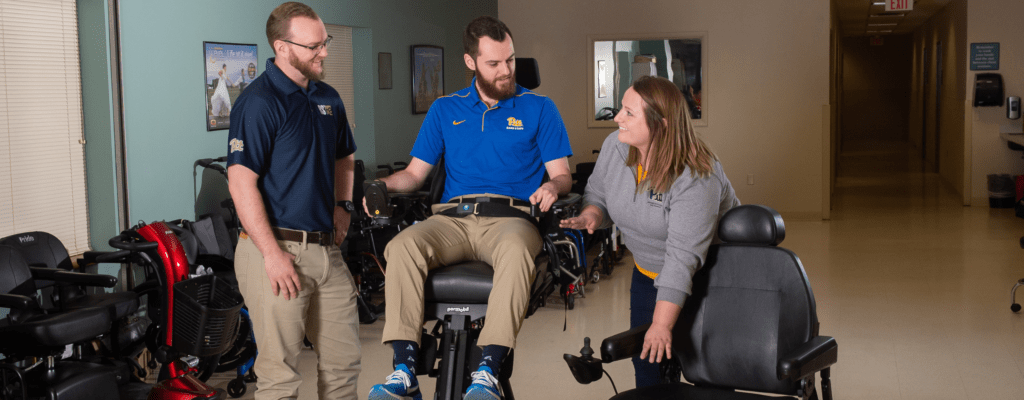
The Department of Rehabilitation Science and Technology offers competitive fellowships to MS students and postdocs. View this scholarship page later in the fall term for possible scholarship opportunities for the following school year.
- Student Research Opportunities
- AccelerATe
- Rehabilitation Services Administration (RSA) Fellowship
RST students are encouraged to apply for external funding. Below is a list of nationally competitive fellowships and funding databases. The links provide a basic summary of each fellowship. If you have specific questions regarding one of these fellowships, please contact the sponsor.
Available Scholarships
- A.T. Anderson Memorial Scholarship (Sponsor: American Indian Science & Engineering Society (AISES)
- Achievement Rewards for College Scientists Foundation (ARCS) Scholar
- American Association of University Women (AAUW)
- American Philosophical Society (APA) John Hope Franklin Dissertation Fellowship
- ASEE/ NSF Small Business Postdoctoral Research Diversity Fellowship
- Awards for African Americans, including Dissertation Research
- Cardiovascular Bioengineering Training Program (CBTP) (Funded by the NIH)
- College Scholarships, Graduate Fellowship & Postdoctoral Awards for Minorities
- Council for International Exchange of Scholars
- Developing Global Scientists and Engineers: International Research Experiences for Students (IRES) and Doctorial Dissertation Enhancement Projects (DDEP)
- Directorate for Social, Behavioral and Economic Sciences (SBE) Doctorial Dissertation Research Grants
- Ford Foundation
- Foundation for Science & Disability
- Howard Hughes Medical Institute-Gilliam Fellowship
- Individual Advanced Research Opportunities Program (IARO)
- K. Leroy Irvis Fellowship
- National GEM Consortium
- National Hispanic Scholarship Fund
- National Institute of General Medical Sciences (Sponsored by NIH)
- National Institutes of Health (NIH) Fellowships – Ruth L. Kirschstein National Research Service Awards
- National Science Foundation (NSF) Graduate Research Fellowship (GRF)
- NSF fellowship
- NSPC Graduate Fellowship
- Research Associateship Programs (Sponsor: National Research Council (NRC) of the National Academies of Sciences
- Ruth L. Kirschstein National Research Service Awards for Individual Predoctoral Fellowships to Promote Diversity in Health-Related Research
- Scholarships4Development Database
- Soros Fellowships for New Americans
- The AAHD Frederick J. Krause Scholarship on Health and Disability – AAHD website.
- The Collegiate Inventors Competition (Sponsor: National Inventors Hall of Fame)
- The Hartwell Foundation
- The National Academies
- The Pittsburgh Foundation
- The Provost’s Office – University of Pittsburgh
- The Scott and Paul Pearsall Scholarship
- Training Grants – The Center for the Neural Basis of Cognition (CNBC)
- University of Pittsburgh, Office of Research
- Whitaker International Award For Bioengineers and Biomedical Engineers
- Woodrow Wilson Teaching Fellowships
AccelerATe
A diverse and well-trained workforce is critical to meet the needs of a growing number of individuals who can benefit from Assistive Technology (AT), a number expected to double from one to two billion people by 2050. To ensure that AT is appropriate for those who need it, the workforce must promote excellence in AT education, design, provision, manufacturing and research. To help fuel this workforce growth, the Department of Rehabilitation Science and Technology (RST) is offering the AccelerATe Scholarship.
Scholars will receive a one-time maximum scholarship award of $5,000 (U.S.) to offset costs associated with RST degree-granting programs including the master’s in either Rehabilitation Technology (RT) or Prosthetics & Orthotics (P&O).
Eligibility
- Demonstrate financial need for the scholarship
How to Apply
Prospective students who submit an application to the Master of Rehabilitation Technology (MRT) and Prosthetics & Orthotics (P&O) programs will receive detailed information on how to apply for an AccelerATe Scholarship.
Application Requirements
- In a few sentences, provide insight as to why you qualify for this scholarship based on financial need.
- Submit an essay of no more than 400 words to provide clear and compelling evidence of leadership supporting the applicants community as well as provide meaningful future contributions to the AT field.
Selection of Awardees
Awardees will be selected by the RST Selection Committee.
Expectations of AccelerATe Scholars
- Maintain a good academic standing of at least a 3.0 GPA in your program and make continuous progress towards your degree.
- Provide a half-page, written overview of your career goals and how the AccelerATe scholarship supported those goals following completion of your graduate degree program.
The AccelerATe Scholarship is sponsored by the Kaufman family.
Rehabilitation Services Administration (RSA) Fellowship
A collaborative team of University of Pittsburgh faculty and external partners has been awarded a five-year, $875,000 training grant from the U.S. Department of Education’s Office of Special Education and Rehabilitative Services (OSERS). The grant, titled “Innovate, Educate, Elevate: Advanced Training in Rehabilitation Technology,” aims to expand the national workforce of highly skilled professionals delivering cutting-edge assistive technology (AT) services, with a focus on transition and vocational rehabilitation.
Over these five years, the initiative will:
- Fully fund 10 master’s students to become leaders in rehabilitation technology.
- Provide advanced training to 70 current professionals to strengthen national AT service capacity.
- Foster collaboration between academia, clinicians, educators, and policymakers to enhance accessibility and employment outcomes for individuals with disabilities.
The project officially launched on October 1, 2025
Training Opportunities
- Master’s in Rehabilitation Technology (MRT)
- Focus: Prepares students for clinical, research, and design careers in rehabilitation and nonprofit settings.
- Support: Full tuition, stipend, and professional development funding for 10 scholars (2 per year).
- See the program’s admissions page for more details.
- Continuing Education + ATP Certification Track
- Focus: Upskills professionals (rehabilitation counselors, OTs, PTs, special educators, technologists) working in vocational rehab or nonprofit settings.
- Support: Free access to online continuing education modules and waived RESNA Assistive Technology Professional (ATP) exam fee.
- Delivery: 100% online and asynchronous.
- Start Date: Flexible entry; ATP prep course offered in the fall semester.
- Size: Up to 14 participants per year (70 total).
- Eligibility: Current employment in a rehabilitation or nonprofit setting.

Master of Rehabilitation Technology Program Awarded $875,000 U.S. Department of Education Training Grant
The five-year grant will expand the national workforce of highly skilled professionals delivering cutting-edge assistive technology services, with a focus on transition and vocational rehabilitation.
Read the full story

Melissa Aleksak
Director of the Adaptive Driving Program, Assistant Professor
melissa.aleksak@pitt.edu





Helen Cochrane
Director of the Prosthetics and Orthotics Program, Assistant Professor
hec65@pitt.edu
Rosemarie Cooper
Associate Director of Stakeholder Engagement at HERL, Associate Professor
cooperm@pitt.edu







Julie Faieta
Director of the Master of Rehabilitation Technology Program, Assistant Professor
juf52@pitt.edu